
invisible protection that
stops cavities before they start
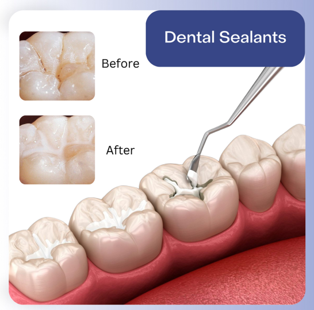
Why molars are the highest-risk teeth — and how sealants fix that
The chewing surfaces of back molars are covered in deep pits and grooves — natural features that give teeth their grinding power but also create tight spaces where food and bacteria collect.
Toothbrush bristles are physically too wide to reach into these grooves, meaning no amount of brushing clears them fully. Decay forms in these crevices silently, often going undetected until a filling is needed. A dental sealant fills these grooves with a thin resin that bonds to the tooth surface, creating a smooth, easy-to-clean barrier that stops bacteria getting in.
How does the procedure work and does it hurt?
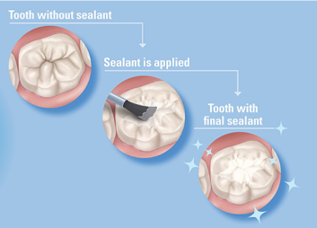
The procedure for dental sealants is easy, non-invasive, and most importantly – painless. After a tooth’s chewing surface has been properly cleaned, rinsed, and dried, the sealant is painted onto it. To help harden the sealant, a light is briefly shined directly on the tooth, forming a smooth, protective shield.
Sealed vs unsealed molars over 10 years
With sealants
- Grooves physically blocked — bacteria can't enter
- Easy to clean with routine brushing
- 80% reduction in molar cavity risk
- No drilling, fillings, or crowns needed
- Lasts 5–10 years, checked at every visit
- Covered 100% for children under most plans
Without sealants
- Deep grooves collect food and bacteria daily
- Toothbrush bristles can't reach inside grooves
- Decay often starts here first — silently
- Typically requires a filling within a few years
- Filling may eventually need a crown
- Significantly higher long-term treatment cost
Simple, quick, and completely painless
Common questions
Do sealants hurt?
No. There is no drilling, no needles, and no anaesthetic. The procedure involves cleaning, drying, and painting on a liquid resin — nothing more. Most children and adults find it completely comfortable. The whole process for four molars takes around 30 minutes.
How long do dental sealants last?
With normal use and good oral hygiene, sealants typically last between 5 and 10 years — sometimes longer. They are assessed at every routine check-up and any worn or chipped areas can be repaired quickly with a new layer of sealant resin. The tooth remains protected for as long as the sealant is intact.